
Reliable in vitro mast cell platform for allergy, safety, and efficacy studies
Genoskin provides integrated in vitro mast cell studies using primary human mast cells for evaluation of compound safety, allergenicity, and efficacy. Our assays are designed to investigate mast cell activation, degranulation, mediator release, and signaling pathways under controlled conditions. Unlike immortalized cell lines, studies are conducted exclusively on primary human mast cells, ensuring higher physiological relevance and improved translational value.
Our in vitro mast cell studies support a wide range of experimental endpoints, including:

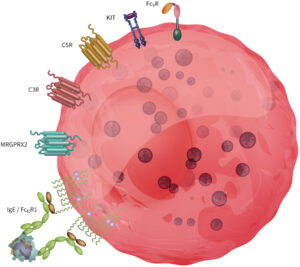
Why use primary human mast cells?
Higher physiological relevance than immortalized cell lines. Primary cells retain the receptors, granule content, and activation thresholds that matter.
Better prediction of clinical outcomes, reducing the risk of late-stage failures.
More accurate modeling of allergic and inflammatory responses across diverse donor backgrounds.
Streamlined workflow for actionable data
Genoskin implements a standardised workflow to generate reliable and actionable data:
STEP 1:
Study Design
Our scientific team defines protocols, stimulation conditions, and analytical endpoints with you.
STEP 2:
Cell Preparation
Primary mast cells are prepared and pre-sensitized with IgE to mimic physiological conditions.
STEP 3:
Compound Exposure
Test articles or specific stimuli are applied to cells to induce and measure mast cell responses.
STEP 4:
Data Analysis
Mast cell activity is characterised via cytokine profiling, enzymatic assays, and flow cytometry.
STEP 5:
Data Reporting
Results are compiled into detailed reports with quantitative analysis and scientific interpretation.
Mast cell applications across allergy, safety, and mechanistic studies

Allergy and Hypersensitivity
Characterisation of mast cell activation pathways
Identification of mast cell stabilizers

Safety and Reactivity Assessment
Early identification of potential irritants or pseudo-allergenic effects

Mechanistic Studies
Investigation of signalling pathways involved in degranulation
Evaluation of inhibition strategies targeting mast cell activation
MRGPRX2-mediated mast cell activation
In Vitro · MRGPRX2
Cetrorelix Triggers Mast Cell Degranulation via MRGPRX2
Cetrorelix induces mast cell degranulation via the MRGPRX2 pathway, validating the platform’s capability to study mast cell-mediated injection site reactions and drug hypersensitivity.
Degranulation quantified by β-hexosaminidase release. One-Way ANOVA with multiple comparisons. * p<0.05; ** p<0.01; *** p<0.001; **** p<0.0001
Mast cell responses in an ex vivo human skin model
Tissue context changes everything
While in vitro systems provide mechanistic insights, mast cells function within a complex tissue environment involving interactions with keratinocytes, fibroblasts, neurons, and other types of immune cells.
Genoskin’s ex vivo human skin models preserve natural tissue architecture and cellular diversity, enabling mast cell studies in a fully functional human microenvironment.
This approach allows investigation of mast cell responses within intact skin, capturing biological interactions not reproducible in isolated in vitro cell systems.
Why use ex vivo skin models for mast cell studies?
Mast cell depletion and modulation studies
Mast cells play dual roles in immunity, contributing to both protective responses and pathological conditions such as allergy and chronic inflammation. As a result, there is a strong interest in modulating or depleting mast cells in a controlled manner.
Mast cell depletion strategies include:
Understanding these mechanisms is critical for developing safe and targeted therapies.
Assessing mast cell depletion in HypoSkin
Ex Vivo · HypoSkin® · MC Depletion
Fc-enhanced anti-KIT antibody depletes mast cells in human skin
Somatic gain-of-function mutations in c-KIT drive ligand-independent mast cell activation in mastocytosis. Fc-silent anti-KIT antibodies such as Barzolvolimab® block signalling but do not deplete malignant mast cells. The goal of this study was to evaluate whether an Fc-engineered anti-KIT monoclonal antibody could achieve effective mast cell depletion in human skin tissue.
Model: HypoSkin®
Test Articles: Fc-silent anti-hKIT antibody or Fc-enhanced anti-hKIT antibody, injected subcutaneously
Culture Duration: 7 days
Analysis: Quantification of mast cells in skin using FACS
Conclusions:
- Fc-enhanced anti-KIT mAbs can deplete mast cells in ex vivo human skin models
- HypoSkin is a relevant model to study mast cell depletion
Data extracted from Worrall et al., submitted
Data pooled from 3 independent experiments, n=3–4 individual skin donors. One-way ANOVA, Kruskal-Wallis multiple comparison.
2 variations for CTAs. Which one do you prefer?
Our ex vivo platform lets you validate mast cell targeting strategies in human skin tissue before entering clinical stages, reducing development risk.
Our ex vivo platform lets you validate mast cell targeting strategies in human skin tissue before entering clinical stages, reducing development risk.
Frequently asked questions
Why use primary human mast cells?
Can studies be customised to specific pathways or targets?
Yes. All mast cell studies are fully customisable, including: specific receptors (FcεRI, MRGPRX2, KIT), biomarkers and readouts, and experimental conditions and stimulation protocols.
When should I use in vitro versus ex vivo models?
Start your mast cell study
Whether you are screening compounds or validating advanced therapies, our team will design a study tailored to your needs.